How to Build Safer Traditional Music & Piping Communities
Written by Holli Scott. Images by Sophie Stringer.
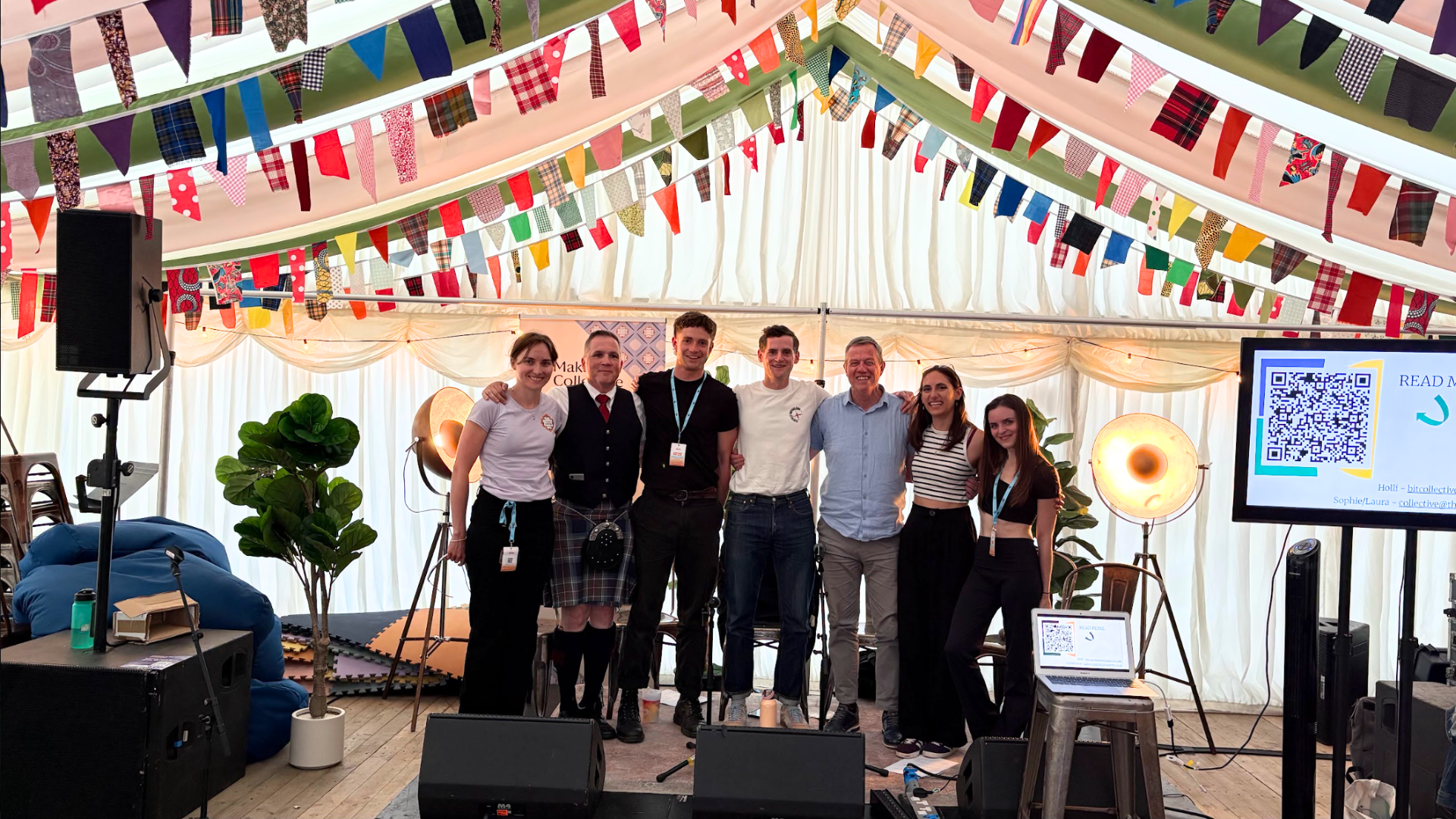
On 13 August 2026, The BIT Collective, in collaboration with the Maket Collective, hosted a panel discussion entitled ‘Building Safer Traditional Music & Piping Communities’ at Piping Live! in Glasgow.
The panel discussion explored the barriers that women and gender minorities continue to face across traditional music and piping, from under-representation and exclusion to harassment and abuse. In particular, gender-based violence (GBV), safeguarding, inclusion and cultural change across traditional music and piping communities was covered, with a particular focus on how men can better understand these experiences and become active allies in creating safer, more inclusive spaces.
Panellists = James Feeney, Bede Patterson, Ewen Henderson, Dougie Pincock
Hosts = Holli Scott, Laura Jane Wilkie
Image from left: Sophie Stringer, James Feeney, Bede Patterson, Ewen Henderson, Dougie Pincock, Holli Scott, Laura Jane Wilkie
We’d like to thank Piping Live! and the National Piping Centre for putting on a fantastic festival and, importantly, for holding space for this conversation as part of the programme. We’d also like to extend our thanks to our panel speakers - Dougie Pincock, Ewen Henderson, Bede Patterson and James Feeney - for sharing their perspectives, experiences and insights, and for engaging so openly with the topic.
Below is a summary of some of the themes discussed by our panellists, reflecting on the challenges facing our communities and the changes we can all contribute to. We hope this encourages further conversation and action towards building safer traditional music and piping communities.
Generational differences
A recurring theme throughout the session was the idea that there is a ‘generational divide’ in how people understand gender-based issues and inclusive practice. Dougie noted that gender issues have only relatively recently entered mainstream discussion. In contrast, Bede noted that younger generations are more willing to openly discuss GBV. The panel agreed that the statistics around GBV in traditional music were not surprising.
There was also recognition across the panel that older men may dismiss or overlook these issues because they have not personally experienced them. Ewen acknowledged that change can be uncomfortable and that some people avoid the conversation because of fear of saying the wrong thing, previous trauma, or because difficult conversations require emotional energy.
“You can either listen and you’ll be stronger for it, or you can ignore it. In which case you’ll become a dinosaur, and you’ll become extinct.”
Safeguarding
The informal nature of traditional music education was identified by the panellists as a key area that can create safeguarding concerns, with residential projects being noted as one of the high risk situations.
The panellists agreed that while most traditional musicians teach without professional qualifications or established institutional structures, Dougie emphasised the importance for all freelance musicians and educators to undertake basic child protection training. Formal policies and procedures are useful because they provide clarity about appropriate responses when concerns arise.
“In education you are guided by policy, and my goodness is it helpful. I would urge everyone working in these scenes to get basic child protection training. It will give you a start in the things that you can do to help”
Ewen discussed the difficulty that faces the sector at present in the absence of formal policies and procedures, stating it is hard to respond to concerns when information is disclosed informally, and especially when the information is second or third-hand. The speakers noted that the scene has blurred or informal hierarchies, making it unclear who someone should report concerns to.
Power and hierarchy
The panel went on to compare the different power structures within piping and traditional music communities.
Bede noted that piping has more visible hierarchical structures, and while traditional music still has power structures, these are less clearly defined. However, the panellists agreed that power imbalances and the potential for abuse of power exists in both environments.
James and Dougie stated that good leadership is an important mechanism for cultural change. They quote the need for people in positions of authority to listen to and respond to issues. Panel hosts - Laura and Holli - took this one step further and said that top-down change amongst leadership needs to work alongside bottom-up cultural change, including informal conversations between peers.
Gender and inclusion
Next, the panel discussed the historically gendered nature of traditional music, and noted that in the past instrumentalists were exclusively male while singers were female. Dougie and James described piping as having a particularly masculine and ‘laddish’ culture. There was discussion of the increasing visibility of women, trans people and queer people in piping, citing the particular examples of Rhona Macdonald Lightfoot, Gael Brown, Sue MacIntyre.
James described how two members of his pipe band transitioned while members of the band. This prompted the band to introduce conversations around gender, pronouns and inclusion, while also requiring members to reconsider their existing practices.
Speaking up and having difficult conversations
A significant part of the discussion considered why people do or do not speak up.
The panel recognised that discussions about GBV and inclusion can initially make people feel criticised or attacked. Dougie and Bede described a tendency among some men to avoid “putting their head above the parapet”.
The panellists all agreed that this attitude prevents meaningful engagement, even when people have positive intentions. They emphasised the importance of creating spaces where people listen, ask questions and acknowledge uncertainty.
“If your heart’s in the right place, don’t think that you’re gonna say the wrong thing”
Laura and Holli reassured the panel that supporting someone who discloses an experience is valuable in itself and that doing ‘the right thing’ does not always mean taking immediate action.
“This is complex and there is not right or wrong. Sometimes just supporting someone in that moment is the most you can do and don’t underestimate in yourself how much that can mean to someone”
Societal change
The panel concluded that cultural change does not need to begin at an institutional or international level. Individual musicians, bands, and organisations can make changes which then have the potential to influence the wider traditional music and piping cultures. Examples of positive change included increased diversity in pipe bands, female-led performances, and greater visibility of queer musicians. The panel viewed these developments as evidence that conversations around diversity are already happening and may contribute to reducing GBV. Ultimately, the discussion presented change as a combination of leadership, education, increased safeguarding protocols, open communication and grassroots activism.
Further info
The Maket Collective was established in 2024 to promote and amplify the voice and talent of women and girls within our piping & drumming community. Through our Collective Ambassadors, conversations & targeted events we are striving to create a positive creative space, where our community can find inspiration and empowerment. Find out more on their website.
See our Help & Support page for a list of key resources including websites, articles, and important contact information regarding themes discussed in this article.
At the event we passed a leaflet (prepared by Laura Jane Wilkie) around to the audience with further info on the key themes above. You can access the leaflet by clicking the button below.